Examples#
Read these in order. Each page adds exactly one idea to the one before it,
and they all drive the same engine: a small Monte-Carlo photon transport
solver, plus a two-stream doubling solver for the spectral pages. Both live
in _solvers.py next to these scripts, and both are deliberately hard to
vectorise, because a sweep library has nothing to offer a closed form.
Every script is runnable on its own:
pixi run -e dev python examples/01_why_a_sweep_library.py
The physics is textbook and its sources are cited in _solvers.py; the
limits that have to hold are asserted in
tests/integration/test_example_solvers.py. Nothing here is calibrated
against a real instrument, and the photon counts are kept small so that this
site can be built in a couple of minutes. A production engine costs seconds
to minutes per point, which is the regime these pages are really about.
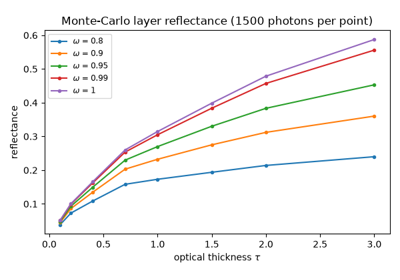

The result is also the cache: store, status and resume
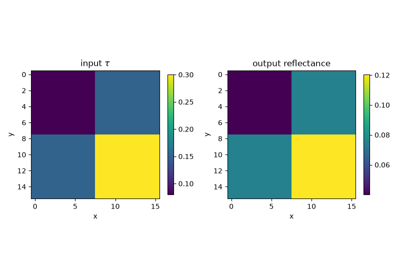
Zip or product: the shape of the sweep comes from your data
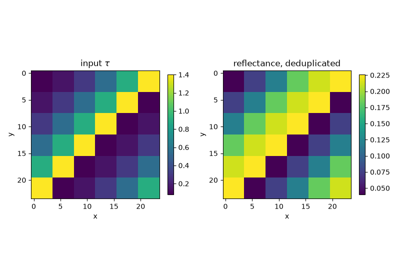
Deduplication: a scene has fewer atmospheres than pixels
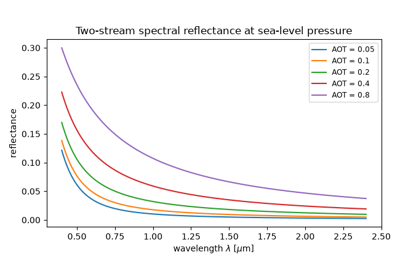
vec: hand over the axis the engine already knows how to do
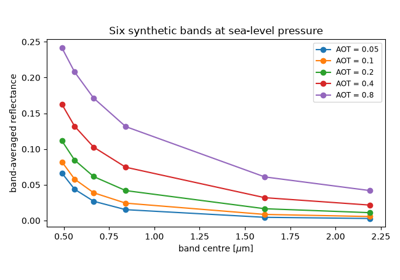
const: context data, and an axis that must not be cut

Policy: the knobs that change what a run costs, never what it returns
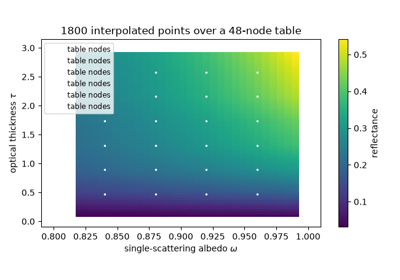
SweepModule: state built once, reused by every call

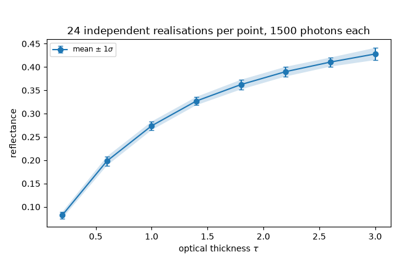
Replication: measuring the noise of a stochastic engine