Note
Go to the end to download the full example code.
Replication: measuring the noise of a stochastic engine#
Every Monte-Carlo number on the preceding pages carries an error bar nobody has drawn yet. Getting one means running the same configuration several times and looking at the spread, which sounds like it needs a “repeat” axis.
It does not, and the reason is worth understanding: a contract loops over
variables, not over dims, so a bare rep dim has nothing to hand the
function. Worse, if it somehow worked it would be a trap, because twenty
identical calls are exactly what the cache and the deduplicator exist to
collapse, and the standard deviation would come back as zero.
The idiom is a carrier variable that makes each repetition genuinely different: the seed.
Run with:
pixi run -e dev python examples/10_replication_and_the_seed.py
from __future__ import annotations

import sys
from pathlib import Path

import matplotlib.pyplot as plt
import numpy as np
import xarray as xr

import xsweep

# sphinx-gallery executes examples without `__file__` set, so the gallery
# directory is located from the already-installed xsweep package instead.
sys.path.insert(0, str(Path(xsweep.__file__).resolve().parents[2] / "examples"))

from _solvers import mc_reflectance  # noqa: E402
from xsweep import SweepPolicy, sweep  # noqa: E402
from xsweep.errors import SpaceError  # noqa: E402
The spelling that does not work#
rep is a dim of the space, not a variable in it, so there is nothing to
pass to the parameter the contract named.
@sweep("loop(tau, rep) -> reflectance()")
def wrong(tau: float, rep: int) -> float:
    """This contract asks for a variable the space does not have."""
    raise AssertionError("unreachable")


bare_dim = xr.Dataset({"tau": ("tau", [0.5, 1.0])}).expand_dims(rep=20)
try:
    wrong.explain(bare_dim)
except SpaceError as error:
    print(f"SpaceError: {error}")
SpaceError: space is missing ['rep'], required by the contract; available variables: tau
The carrier variable#
seed is an ordinary swept variable that happens to live on a dim called
rep. Each repetition is now a distinct point: individually
reproducible, individually cacheable, and resumable like any other.
CALLS = {"n": 0}


@sweep("loop(tau, seed) -> reflectance()")
def replicated(tau: float, seed: int) -> float:
    """Monte-Carlo reflectance, one independent realisation per seed."""
    CALLS["n"] += 1
    return mc_reflectance(tau, 0.95, g=0.6, mu0=0.5, n_photons=1500, seed=int(seed))[
        "reflectance"
    ]


space = xr.Dataset(
    {
        "tau": ("tau", np.linspace(0.2, 3.0, 8)),
        "seed": ("rep", np.arange(24)),
    }
)

print(replicated.explain(space))
+- replicated (v0) -------------------------------------------+
| loop(tau, seed) -> reflectance()
+------------------------------------------------------------+

SPACE
  tau        axis                 8
  rep        axis                24
  points                        192
  dedup                      disabled

CALLS
  to compute      192
  cached            0
  skipped           0
  total           192

ARGUMENTS
  tau          loop    float64
  seed         loop    int64

RESULT
  reflectance (tau: 8, rep: 24) float64

STORE      none (in-memory: no cache, no resume)
EXECUTOR   serial
The result carries the rep dim the carrier put it on, so the ensemble
statistics are one xarray reduction away.
result = replicated(space)
mean = result.reflectance.mean("rep")
spread = result.reflectance.std("rep")

print(f"{CALLS['n']} calls")
print(f"\n{'tau':>5} {'mean':>8} {'std':>8} {'rel':>7}")
for tau in space.tau.values:
    m = float(mean.sel(tau=tau))
    s = float(spread.sel(tau=tau))
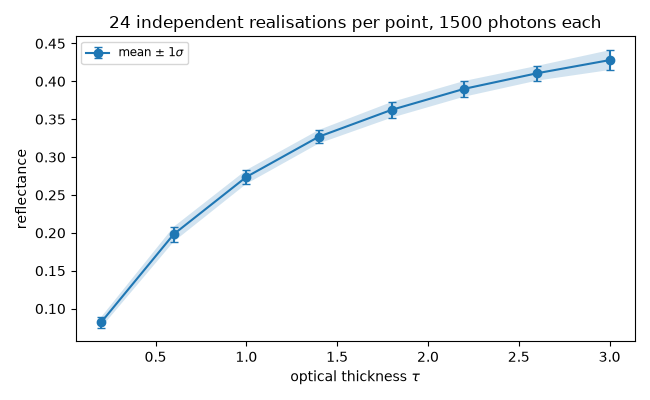
    print(f"{tau:5.2f} {m:8.4f} {s:8.4f} {s / m:6.1%}")
192 calls

  tau     mean      std     rel
 0.20   0.0818   0.0069   8.4%
 0.60   0.1982   0.0098   4.9%
 1.00   0.2738   0.0091   3.3%
 1.40   0.3270   0.0089   2.7%
 1.80   0.3623   0.0103   2.9%
 2.20   0.3901   0.0104   2.7%
 2.60   0.4106   0.0097   2.4%
 3.00   0.4280   0.0131   3.1%
Why deduplication would have eaten it#
The point of the seed is that the rows really are distinct. Turn deduplication on and the call count does not move, because there is nothing to collapse. Had the repetitions been identical, it would have collapsed them to one and the spread above would have been exactly zero.
CALLS["n"] = 0
deduped = replicated(space, policy=SweepPolicy(dedup=True))
print(f"dedup=True: {CALLS['n']} calls, {space.tau.size * space.rep.size} points")
np.testing.assert_array_equal(result.reflectance.values, deduped.reflectance.values)

identical = xr.Dataset(
    {"tau": ("tau", np.linspace(0.2, 3.0, 8)), "seed": ("rep", np.zeros(24, dtype=int))}
)
print(
    f"same seed everywhere: "
    f"{replicated.explain(identical, policy=SweepPolicy(dedup=True)).n_calls} calls "
    f"for {identical.tau.size * identical.rep.size} points, "
    f"and a spread of exactly zero"
)
dedup=True: 192 calls, 192 points
same seed everywhere: 8 calls for 192 points, and a spread of exactly zero
The error bar the rest of the gallery was missing#
This is the number page 08 needed before it could claim anything about interpolation error: at 1500 photons the engine’s own one-sigma noise is around 0.01 in reflectance, roughly 3% of the value, and it shrinks as the square root of the photon count and no faster. Quadrupling the photons halves the bar; there is no cheaper way to buy a digit.
fig, ax = plt.subplots(figsize=(6.5, 4.0))
ax.errorbar(
    space.tau, mean, yerr=spread, marker="o", capsize=3, label="mean $\\pm$ 1$\\sigma$"
)
ax.fill_between(space.tau, mean - spread, mean + spread, alpha=0.2)
ax.set_xlabel(r"optical thickness $\tau$")
ax.set_ylabel("reflectance")
ax.set_title("24 independent realisations per point, 1500 photons each")
ax.legend(fontsize="small")
fig.tight_layout()
plt.show()
Total running time of the script: (0 minutes 3.957 seconds)