Note
Go to the end to download the full example code.
Zip or product: the shape of the sweep comes from your data#
The contract never says how many points there are, or whether two variables
vary together. That is already written in the dims of the Dataset you
pass:
variables sharing a dim vary together (a zip): one point per position;
variables on distinct dims multiply (a Cartesian product).
One contract, loop(tau, ssa) -> reflectance(), transmittance(), serves a
parameter study and a satellite scene without a character changing. This page
never calls the engine: it only asks explain what each space would cost,
which is the cheapest place to catch the mistake this design makes possible.
Run with:
pixi run -e dev python examples/03_zip_or_product.py
from __future__ import annotations

import sys
from pathlib import Path

import matplotlib.pyplot as plt
import numpy as np
import xarray as xr

import xsweep

# sphinx-gallery executes examples without `__file__` set, so the gallery
# directory is located from the already-installed xsweep package instead.
sys.path.insert(0, str(Path(xsweep.__file__).resolve().parents[2] / "examples"))

from _scene import atmosphere_scene  # noqa: E402
from _solvers import mc_reflectance  # noqa: E402
from xsweep import sweep  # noqa: E402

N_PHOTONS = 1500
CALLS = {"n": 0}


@sweep("loop(tau, ssa) -> reflectance(), transmittance()")
def layer(tau: float, ssa: float) -> dict[str, float]:
    """Reflectance and transmittance of a scattering layer, by Monte-Carlo."""
    CALLS["n"] += 1
    return mc_reflectance(tau, ssa, g=0.6, mu0=0.5, n_photons=N_PHOTONS, seed=0)
A parameter study: distinct dims, so a product#
This is the space from page 01. tau is on dim tau and ssa on
dim ssa, so every combination is wanted: 12 x 5 = 60 points.
study = xr.Dataset(
    {
        "tau": ("tau", np.linspace(0.1, 3.0, 12)),
        "ssa": ("ssa", np.array([0.85, 0.9, 0.95, 0.99, 1.0])),
    }
)
print(layer.explain(study))
+- layer (v0) ------------------------------------------------+
| loop(tau, ssa) -> reflectance(), transmittance()
+------------------------------------------------------------+

SPACE
  tau        axis                12
  ssa        axis                 5
  points                         60
  dedup                      disabled

CALLS
  to compute       60
  cached            0
  skipped           0
  total            60

ARGUMENTS
  tau          loop    float64
  ssa          loop    float64

RESULT
  reflectance (tau: 12, ssa: 5) float64
  transmittance (tau: 12, ssa: 5) float64

STORE      none (in-memory: no cache, no resume)
EXECUTOR   serial
The mistake this makes possible#
Two variables that were meant to vary together, declared on different dims by accident, silently become every combination of themselves. Nothing about the code looks wrong; the point count is the only symptom.
flat_tau = tau_map.ravel()[:200]
flat_ssa = ssa_map.ravel()[:200]

correct = xr.Dataset({"tau": ("pixel", flat_tau), "ssa": ("pixel", flat_ssa)})
by_accident = xr.Dataset({"tau": ("pixel", flat_tau), "ssa": ("point", flat_ssa)})

print(
    f"same dim,      zipped:   {correct.sizes} -> {layer.explain(correct).n_points} points"
)
print(
    f"different dims, product: {by_accident.sizes} -> "
    f"{layer.explain(by_accident).n_points} points"
)
print(
    f"\nratio: {layer.explain(by_accident).n_points // layer.explain(correct).n_points}x more work"
)
same dim,      zipped:   Frozen({'pixel': 200}) -> 200 points
different dims, product: Frozen({'pixel': 200, 'point': 200}) -> 40000 points

ratio: 200x more work
With an engine costing milliseconds that is an annoyance. At seconds per
call it is the difference between an afternoon and a fortnight, which is
why explain exists and why it makes no calls.
per_call = 4.0
for name, space in (("zipped", correct), ("product", by_accident)):
    n = layer.explain(space).n_points
    print(f"{name:>8}: {n:>6} points x {per_call:.0f} s = {n * per_call / 3600:8.2f} h")
 zipped:    200 points x 4 s =     0.22 h
product:  40000 points x 4 s =    44.44 h
Running the zipped scene#
A small corner of the scene, to show the result keeps the map’s own dims: the output is an image, not a list of points to reshape by hand.
corner = scene.isel(y=slice(0, 16), x=slice(0, 16))
result = layer(corner)

print(f"calls made: {CALLS['n']}")
print(result)
calls made: 256
<xarray.Dataset> Size: 5kB
Dimensions:        (y: 16, x: 16)
Coordinates:
  * y              (y) int64 128B 0 1 2 3 4 5 6 7 8 9 10 11 12 13 14 15
  * x              (x) int64 128B 0 1 2 3 4 5 6 7 8 9 10 11 12 13 14 15
Data variables:
    reflectance    (y, x) float64 2kB 0.04013 0.04013 0.04013 ... 0.1203 0.1203
    status         (y, x) uint8 256B 1 1 1 1 1 1 1 1 1 1 ... 1 1 1 1 1 1 1 1 1 1
    transmittance  (y, x) float64 2kB 0.9581 0.9581 0.9581 ... 0.8449 0.8449
Attributes:
    xsweep_meta:  {'fingerprint': 'c75440b5e5781a049d84b68e7664d441', 'contra...
256 pixels, 256 calls. The scene is built from six atmosphere classes and this corner holds three of them, so most of those calls recomputed a point the engine had already produced. That is the next page.
distinct = np.unique(
    np.stack([corner.tau.values.ravel(), corner.ssa.values.ravel()]).T, axis=0
)
print(f"pixels: {corner.tau.size}, distinct atmospheres: {len(distinct)}")

fig, axes = plt.subplots(1, 2, figsize=(8.0, 3.4))
for ax, (data, title) in zip(
    axes,
    ((corner.tau, r"input $\tau$"), (result.reflectance, "output reflectance")),
    strict=True,
):
    image = ax.imshow(data, origin="upper", cmap="viridis")
    ax.set_title(title)
    ax.set_xlabel("x")
    ax.set_ylabel("y")
    fig.colorbar(image, ax=ax, shrink=0.85)
fig.tight_layout()
plt.show()
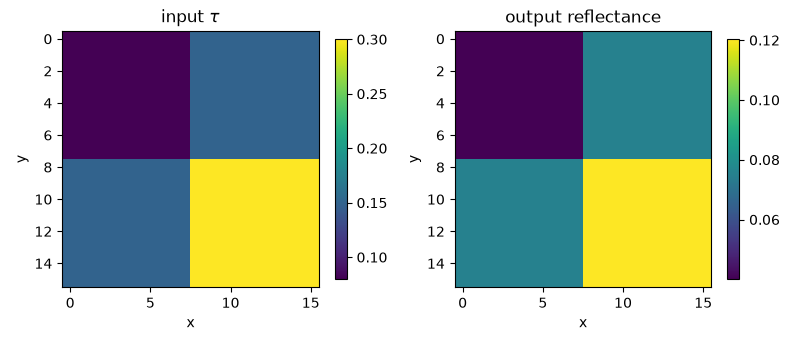
pixels: 256, distinct atmospheres: 3
Total running time of the script: (0 minutes 0.817 seconds)